Fabrics of Memory: The New Centre Gadbois
by Yolene Handabaka Ames, published 2026-03-24
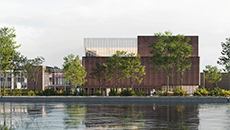
The Centre Gadbois occupies a paradoxical place in Montréal’s collective imagination. Built in 1960 as part of the city’s democratization of sport , it has since been transformed through incremental additions, surviving the shadow of the Turcot interchange while serving generations of athletes and citizens. As Montréal reimagined this emblematic facility, the design competition for its renovation and partial reconstruction became more than a technical exercise: it was an inquiry into how memory, landscape, and community can be rewoven into the very fabric of architecture. Thus, the new centre Gadbois would display the heritage elements of the original building, would integrate with the surrounding urban fabric, and would provide the community with improved access to sports and recreation.
The objective of the two-stage multidisciplinary architectural competition launched by the Ville de Montréal in 2023 was the design of the project to renovate and partially rebuild the Centre Gadbois, a building of heritage interest and an important community sports facility located in the borough of Le Sud-Ouest, near the Turcot Interchange and the Lachine Canal National Historic Site.
The competition brief was demanding. It required minimal demolition and restoration of key features of the 1960 structure, the reorganization of an intricate interior, and the creation of a central civic space. Urban integration was key: the building must open itself to Gadbois Park, the woonerf Saint-Pierre , and the canal, while addressing the scars of highway infrastructure. Ecological transition was equally central, with LEED Silver as a baseline and broader goals aligned with Montréal’s Agenda 2030. And beyond the technical, the project had to embody inclusivity through ADS+ principles, ensuring that Gadbois speaks to all citizens.
The multidisciplinary jury was composed of 8 members including Richard de la Riva, architect at Affleck de la Riva architects; Cesar Herrera, architect at Coarchitecture; Dinu Bumbaru, policy director of Heritage Montréal; Laurence Fournier, Olympic athlete; Catherine Lavigne, director of Gadbois Gymnastics Club as well as two architects and an engineer from the Ville de Montréal; mainly by architects, an engineer, a heritage specialist, and sports specialists. The prize was awarded based on seven criteria: “contribution to urban integration and development of the site; architectural quality, circulation and intuitive orientation; compliance with the functional and technical program; quality of engineering solutions; measures for ecological transition and sustainable development, and budget feasibility” . Of the twenty-nine teams who submitted anonymous proposals during the first stage of the competition, the jury selected four multidisciplinary finalist teams: 14) Ruccolo + Faubert architects inc., Marchand Houle & Associés inc., SDK et Associés inc., Dupras Ledoux inc.; 21) Atelier Big City + Cimaise, SNC-Lavalin inc., Groupe Geniex inc., Ambioner inc.; 32) BGLA architecture + Design Urbain, Les Services EXP inc., Latéral, l’Enclume; 43) Prisme + ADHOC inc., GBI Experts-Conseils inc. et 4) Ruccolo + Faubert architects inc., Marchand Houle & Associés inc., SDK et Associés inc., Dupras Ledoux inc. These teams answered with sharply different visions, each weaving material, urban, social and ecological “fabrics of memory” in their projects.
The first finalist team,Ruccolo + Faubert dissolves the boundary between building and park through the concept of the Hyperparc. By partially burying volumes and extending Gadbois Park over vegetated roofs, the project reimagines the centre as landform architecture. The Hyperparc becomes not only infrastructure but also a public amenity, democratizing access to views, gardens, and heritage interpretation. Inside the facility, the ‘avenue intérieure’ provides a linear spine connecting east and south entries, culminating in a triple-height agora. Materially, the project respects the 1960 heritage while integrating copper-toned ceramics that resonate the patina of existing details.
The jury praised the project’s distinctive architecture and bold urban integration. The accessible green roof was seen as a potential landmark, while the decision not to stack sports platforms preserved a human scale. Nevertheless, these ambitions come with risks. The project is visionary but challenging in feasibility since ecological maintenance could inflate costs. By dissolving into the landscape, Gadbois may also sacrifice its legibility as a civic institution. The jury doubted the usability of the green roof given highway noise and pollution, and the incursion into the park was not seen as adequately offset.
If Ruccolo + Faubert’s project represents landform architecture, Atelier Big City + Cimaise represents contrast and spectacle. The team offers the most extroverted and metropolitan vision of the Centre Gadbois. The cantilevered palestre projects toward the Turcot interchange, projecting Gadbois as a landmark of Montréal’s urban identity. Socially, this is a centre of visibility and performance: athletes in action are on display, the agora becomes a stage set, and architecture itself becomes signal.
Inside, two perpendicular axes structure circulation. At their intersection, the Agora of Athletes rises through four levels, with tall wood columns that evoke an interior forest. Stairs zigzag through the void, dramatizing movement as spectacle. The jury described the project as audacious and even heroic, applauding its ability to reassert Gadbois’ presence within a highway-dominated landscape.
The very spectacle that defines the project also exposes its vulnerabilities. The cantilever can potentially overshadow the modest 1960 building and attenuate heritage continuity. The jury warnedinformed that the proposal, though iconic, perpetuates the kind of additive expansion criticized at Gadbois.
BGLA Architecture’s proposal follows a totally different approach. The team privileges continuity over contrast. Through selective demolition, the team removes the 1980s additions, restoring legibility to the original 1960 structure. The project’s strength lies in its central courtyard that serves simultaneously as orientation device, agora, and civic heart. Besides, outdoor amenities extend Gadbois into the park, reinforcing permeability and active mobility. BGLA thus weaves a fabric of care and inclusivity, less bold than others, but profoundly civic. The jury highlighted the sensitive integration into both the existing building and its urban setting. The added volume was seen as well-composed, the inner garden as a source of light and orientation, and the gymnasium’s direct relationship to the park as an asset. Simplicity and clarity of construction were also recognized as ensuring budget feasibility.
However, the same restraint can be interpreted as over-caution. A language of coherence may result in a building that lacks metropolitan presence. Without strong programming, the courtyard could feel more infrastructural than civic, a void rather than a vibrant agora. The jury expressed their concerns over the enlargement of the courtyard at it weakens the historic gasometer reference and fragments circulation. Besides, questions of universal accessibility remained unresolved, while the palestre’s isolation risked marginalizing families with children.
The winning team, Prisme + ADHOC, proposed a careful stitching strategy, anchored by the conversion of the old gymnasium into an agora. This luminous hub of civic life connects to Gadbois Park via the extended Woonerf Saint-Pierre, clarifying orientation and positioning Gadbois as a commons. Its layered architectural expression balances continuity with innovation, while circular-economy principles, geothermal wells, natural ventilation, and hybrid wood–steel structures aim beyond carbon-zero standards. Most compelling is the project’s social fabric: the agora doubles as a flexible stage for exhibitions, events, and everyday encounters, redefining Gadbois as a civic commons where heritage and inclusivity reinforce one another.
The jury praised the project’s restrained and sensitive approach, noting its pragmatic clarity and the way its brick expression ties the new intervention to the district’s industrial heritage. The transformation of the former gymnasium into an agora was judged particularly judicious, as was the integration of generous natural light and the dual east–south entrances. The proposal was described as skillful, sensitive, and honest, with the new volume in the park fully assumed and well explained.
In conclusion, the Gadbois competition shows that contemporary public architecture in Montréal is less about objects in isolation than about weaving together material, urban, social, and ecological fabrics. Each finalist reinterpreted memory differently through landform, spectacle, continuity, and stitching. None is perfect, and the jury was keen to highlight both strengths and shortcomings. Yet this plurality is itself instructive. It reveals that Gadbois is not only a sports facility, but a social condenser ,and a civic commons. where Montréal’s fabrics of memory can be actively rewoven. Heritage here is not static preservation, but a living cloth that must be repaired, extended, and reimagined if it is to be worn anew by future generations.
The objective of the two-stage multidisciplinary architectural competition launched by the Ville de Montréal in 2023 was the design of the project to renovate and partially rebuild the Centre Gadbois, a building of heritage interest and an important community sports facility located in the borough of Le Sud-Ouest, near the Turcot Interchange and the Lachine Canal National Historic Site.
The competition brief was demanding. It required minimal demolition and restoration of key features of the 1960 structure, the reorganization of an intricate interior, and the creation of a central civic space. Urban integration was key: the building must open itself to Gadbois Park, the woonerf Saint-Pierre , and the canal, while addressing the scars of highway infrastructure. Ecological transition was equally central, with LEED Silver as a baseline and broader goals aligned with Montréal’s Agenda 2030. And beyond the technical, the project had to embody inclusivity through ADS+ principles, ensuring that Gadbois speaks to all citizens.
The multidisciplinary jury was composed of 8 members including Richard de la Riva, architect at Affleck de la Riva architects; Cesar Herrera, architect at Coarchitecture; Dinu Bumbaru, policy director of Heritage Montréal; Laurence Fournier, Olympic athlete; Catherine Lavigne, director of Gadbois Gymnastics Club as well as two architects and an engineer from the Ville de Montréal; mainly by architects, an engineer, a heritage specialist, and sports specialists. The prize was awarded based on seven criteria: “contribution to urban integration and development of the site; architectural quality, circulation and intuitive orientation; compliance with the functional and technical program; quality of engineering solutions; measures for ecological transition and sustainable development, and budget feasibility” . Of the twenty-nine teams who submitted anonymous proposals during the first stage of the competition, the jury selected four multidisciplinary finalist teams: 14) Ruccolo + Faubert architects inc., Marchand Houle & Associés inc., SDK et Associés inc., Dupras Ledoux inc.; 21) Atelier Big City + Cimaise, SNC-Lavalin inc., Groupe Geniex inc., Ambioner inc.; 32) BGLA architecture + Design Urbain, Les Services EXP inc., Latéral, l’Enclume; 43) Prisme + ADHOC inc., GBI Experts-Conseils inc. et 4) Ruccolo + Faubert architects inc., Marchand Houle & Associés inc., SDK et Associés inc., Dupras Ledoux inc. These teams answered with sharply different visions, each weaving material, urban, social and ecological “fabrics of memory” in their projects.
The first finalist team,Ruccolo + Faubert dissolves the boundary between building and park through the concept of the Hyperparc. By partially burying volumes and extending Gadbois Park over vegetated roofs, the project reimagines the centre as landform architecture. The Hyperparc becomes not only infrastructure but also a public amenity, democratizing access to views, gardens, and heritage interpretation. Inside the facility, the ‘avenue intérieure’ provides a linear spine connecting east and south entries, culminating in a triple-height agora. Materially, the project respects the 1960 heritage while integrating copper-toned ceramics that resonate the patina of existing details.
The jury praised the project’s distinctive architecture and bold urban integration. The accessible green roof was seen as a potential landmark, while the decision not to stack sports platforms preserved a human scale. Nevertheless, these ambitions come with risks. The project is visionary but challenging in feasibility since ecological maintenance could inflate costs. By dissolving into the landscape, Gadbois may also sacrifice its legibility as a civic institution. The jury doubted the usability of the green roof given highway noise and pollution, and the incursion into the park was not seen as adequately offset.
If Ruccolo + Faubert’s project represents landform architecture, Atelier Big City + Cimaise represents contrast and spectacle. The team offers the most extroverted and metropolitan vision of the Centre Gadbois. The cantilevered palestre projects toward the Turcot interchange, projecting Gadbois as a landmark of Montréal’s urban identity. Socially, this is a centre of visibility and performance: athletes in action are on display, the agora becomes a stage set, and architecture itself becomes signal.
Inside, two perpendicular axes structure circulation. At their intersection, the Agora of Athletes rises through four levels, with tall wood columns that evoke an interior forest. Stairs zigzag through the void, dramatizing movement as spectacle. The jury described the project as audacious and even heroic, applauding its ability to reassert Gadbois’ presence within a highway-dominated landscape.
The very spectacle that defines the project also exposes its vulnerabilities. The cantilever can potentially overshadow the modest 1960 building and attenuate heritage continuity. The jury warnedinformed that the proposal, though iconic, perpetuates the kind of additive expansion criticized at Gadbois.
BGLA Architecture’s proposal follows a totally different approach. The team privileges continuity over contrast. Through selective demolition, the team removes the 1980s additions, restoring legibility to the original 1960 structure. The project’s strength lies in its central courtyard that serves simultaneously as orientation device, agora, and civic heart. Besides, outdoor amenities extend Gadbois into the park, reinforcing permeability and active mobility. BGLA thus weaves a fabric of care and inclusivity, less bold than others, but profoundly civic. The jury highlighted the sensitive integration into both the existing building and its urban setting. The added volume was seen as well-composed, the inner garden as a source of light and orientation, and the gymnasium’s direct relationship to the park as an asset. Simplicity and clarity of construction were also recognized as ensuring budget feasibility.
However, the same restraint can be interpreted as over-caution. A language of coherence may result in a building that lacks metropolitan presence. Without strong programming, the courtyard could feel more infrastructural than civic, a void rather than a vibrant agora. The jury expressed their concerns over the enlargement of the courtyard at it weakens the historic gasometer reference and fragments circulation. Besides, questions of universal accessibility remained unresolved, while the palestre’s isolation risked marginalizing families with children.
The winning team, Prisme + ADHOC, proposed a careful stitching strategy, anchored by the conversion of the old gymnasium into an agora. This luminous hub of civic life connects to Gadbois Park via the extended Woonerf Saint-Pierre, clarifying orientation and positioning Gadbois as a commons. Its layered architectural expression balances continuity with innovation, while circular-economy principles, geothermal wells, natural ventilation, and hybrid wood–steel structures aim beyond carbon-zero standards. Most compelling is the project’s social fabric: the agora doubles as a flexible stage for exhibitions, events, and everyday encounters, redefining Gadbois as a civic commons where heritage and inclusivity reinforce one another.
The jury praised the project’s restrained and sensitive approach, noting its pragmatic clarity and the way its brick expression ties the new intervention to the district’s industrial heritage. The transformation of the former gymnasium into an agora was judged particularly judicious, as was the integration of generous natural light and the dual east–south entrances. The proposal was described as skillful, sensitive, and honest, with the new volume in the park fully assumed and well explained.
In conclusion, the Gadbois competition shows that contemporary public architecture in Montréal is less about objects in isolation than about weaving together material, urban, social, and ecological fabrics. Each finalist reinterpreted memory differently through landform, spectacle, continuity, and stitching. None is perfect, and the jury was keen to highlight both strengths and shortcomings. Yet this plurality is itself instructive. It reveals that Gadbois is not only a sports facility, but a social condenser ,and a civic commons. where Montréal’s fabrics of memory can be actively rewoven. Heritage here is not static preservation, but a living cloth that must be repaired, extended, and reimagined if it is to be worn anew by future generations.