Dispersed Roof: Iconic Architecture and Reuse
by Yolene Handabaka Ames, published 2026-06-23
The roof of the Montreal Olympic Stadium holds a unique place in the collective imagination of Quebec. More than just a technical structure, for nearly half a century it has represented the monumental ambition of the 1976 Olympic Games, the city’s modernist legacy and one of Montreal’s most recognizable architectural symbols. Yet this roof has reached the end of its life cycle. Its deconstruction thus raises a question rarely asked in architecture: what becomes of a monument when its materials outlive its own architecture?
In the spring of 2024, the Montreal Olympic Park launched an international design and architecture ideas competition dedicated to the reuse of materials from the Olympic Stadium’s current roof. Open to professionals and students worldwide, the competition aimed to fuel discussions about the future of the roof’s components through creative, ecological and socially impactful proposals . Presented by the organizers as “an Olympic ambition,” the initiative sought to reuse, recycle and repurpose most materials resulting from the roof’s dismantling, including cables, membranes and connector assemblies, to give them a second life for the benefit of the Quebec community . This approach was part of the broader principles of the circular economy, ecological transition and urban resilience promoted by the competition.
The diversity of submissions reflected a jury comprised of nine specialists from architecture, design, engineering, environment and circular economy. Chaired by architect and engineer Jean Beaudoin, the jury included architects Rami Bebawi, Stéphanie Cardinal and Manuel R. Cisneros; industrial designer Eugénie Manseau; designer and professor Ying Gao; engineer Jorge Chenevey; and Annie Levasseur, a recognized expert on circular economy and climate resilience issues in the built environment. The presence of Michel Labrecque, President and CEO of the Olympic Park from 2014 to 2024, also anchored the discussions in the institutional and territorial realities of the Olympic site. This multidisciplinary composition made it possible to evaluate the projects not only for their architectural quality, but also for their environmental, social, technical and cultural relevance.
The competition focused on the reuse of the Olympic roof did not merely seek to solve a technical or environmental problem. In fact, it prompted a much deeper reflection on material memory, circular economy and the ability of iconic architecture to continue to exist through its fragments. Participants were invited to reimagine the roof’s main components: cables, membranes and connector assemblies to give them a second life in the contemporary city.
The questions posed by the competition revealed this ambition: Could the cables create new collective connections? Could the membranes extend their use and enhance the traces of time? Could the connectors become new urban landmarks capable of conveying the message of circular architecture? Behind these technical questions lay a fundamental reflection on the transformation of modern heritage. The monument was no longer viewed as a static object to be preserved in its entirety, but as a resource capable of fragmenting, dispersing and reassembling itself in new contexts.
One of the most fascinating aspects of the competition lies precisely in this reversal of logic. The Olympic Stadium had been conceived as a unifying gesture: a monumental, unique piece of architecture, visible across the entire city. However, most of the proposed projects instead envision a diffusion of the monument across the Montreal landscape. The roof ceases to be a single object and becomes a network of interventions, micro-architectures, landscapes and collective infrastructure. The icon is thus transformed into a constellation.
The competition recognized eight winning proposals across professional and student categories, awarding distinctions in urban planning, innovation and environmental impact, product development and complete material reuse. While these categories reflect the multidisciplinary ambitions of the competition, the projects themselves reveal broader conceptual affinities that transcend the official awards. Read together, they outline distinct visions of what the afterlife of an architectural icon might become.
Several winning projects align with a territorial logic that disperses the Olympic monument across Montreal rather than preserving it as a singular object. LES TOITS, MODULE-V and ÉCHO OLYMPIQUE each imagine the roof as a network of interventions distributed throughout the city. While LES TOITS transforms its components into a civic constellation of gathering spaces, MODULE-V develops a modular vocabulary of infrastructures capable of supporting active mobility and community uses. ÉCHO OLYMPIQUE adds a social dimension by linking interventions to specific urban challenges such as heat islands, food security and cultural programming. Despite their differences, these projects share a common ambition: to democratize access to the Olympic legacy by shifting it from a centralized icon to a distributed civic infrastructure.
Other proposals focus on environmental performance and urban resilience. RE_SOURCE envisions a comprehensive circular economy ecosystem combining material banks, community workshops, urban agriculture and training spaces, positioning reuse as a catalyst for social and ecological transformation. IONOSPHÈRE adopts a more speculative approach by transforming roof membranes into air-filtration systems integrated into Montreal bus shelters, directly connecting Olympic heritage to contemporary climate challenges. Although they operate at different scales, both projects move beyond material conservation to imagine the roof as an active environmental infrastructure capable of addressing future urban vulnerabilities.
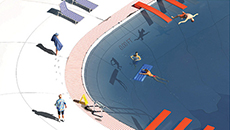
A third group of projects emphasizes collective uses, sociability and public experience. FLOAT reimagines roof components as floating platforms on the St. Lawrence River, reconnecting Montreal to its waterfront through spaces for recreation and contemplation. FLOTTE-DE-LYS proposes lightweight structures that combine shade, rainwater harvesting and urban agriculture within Olympic Park, while ESTADE transforms the membranes into mobile, adaptable systems such as temporary pergolas, inflatable seating and event infrastructures. LES JARDINS DU RENOUVEAU similarly explores the roof's symbolic potential through street furniture, pergolas and green installations that evoke a renewed industrial archaeology. Together, these projects suggest that the Olympic legacy may survive not through permanence or monumentality, but through everyday experiences of comfort, encounter and collective appropriation.
Through these different approaches, the competition reveals several fundamental tensions. Some projects seek to preserve the visual and symbolic identity of the Olympic Stadium, while others embrace an almost complete transformation of the materials. Some prioritize the monumental gesture; others focus on discreet dispersion across the site. Several proposals also oscillate between technical realism and conceptual speculation. This diversity is likely the competition’s greatest strength.
Beyond the differences between the projects, a common idea seems to emerge: modern heritage can no longer be conceived solely as a static object to be preserved intact. The reuse of the Olympic roof, on the contrary, offers a dynamic and evolving vision of heritage, where memory survives through the transformation of materials, uses and territories. The monument does not disappear; it disperses throughout the city, surviving no longer as a single object but as a constellation of fragments capable of producing new memories and new collective imaginaries.
In the spring of 2024, the Montreal Olympic Park launched an international design and architecture ideas competition dedicated to the reuse of materials from the Olympic Stadium’s current roof. Open to professionals and students worldwide, the competition aimed to fuel discussions about the future of the roof’s components through creative, ecological and socially impactful proposals . Presented by the organizers as “an Olympic ambition,” the initiative sought to reuse, recycle and repurpose most materials resulting from the roof’s dismantling, including cables, membranes and connector assemblies, to give them a second life for the benefit of the Quebec community . This approach was part of the broader principles of the circular economy, ecological transition and urban resilience promoted by the competition.
The diversity of submissions reflected a jury comprised of nine specialists from architecture, design, engineering, environment and circular economy. Chaired by architect and engineer Jean Beaudoin, the jury included architects Rami Bebawi, Stéphanie Cardinal and Manuel R. Cisneros; industrial designer Eugénie Manseau; designer and professor Ying Gao; engineer Jorge Chenevey; and Annie Levasseur, a recognized expert on circular economy and climate resilience issues in the built environment. The presence of Michel Labrecque, President and CEO of the Olympic Park from 2014 to 2024, also anchored the discussions in the institutional and territorial realities of the Olympic site. This multidisciplinary composition made it possible to evaluate the projects not only for their architectural quality, but also for their environmental, social, technical and cultural relevance.
The competition focused on the reuse of the Olympic roof did not merely seek to solve a technical or environmental problem. In fact, it prompted a much deeper reflection on material memory, circular economy and the ability of iconic architecture to continue to exist through its fragments. Participants were invited to reimagine the roof’s main components: cables, membranes and connector assemblies to give them a second life in the contemporary city.
The questions posed by the competition revealed this ambition: Could the cables create new collective connections? Could the membranes extend their use and enhance the traces of time? Could the connectors become new urban landmarks capable of conveying the message of circular architecture? Behind these technical questions lay a fundamental reflection on the transformation of modern heritage. The monument was no longer viewed as a static object to be preserved in its entirety, but as a resource capable of fragmenting, dispersing and reassembling itself in new contexts.
One of the most fascinating aspects of the competition lies precisely in this reversal of logic. The Olympic Stadium had been conceived as a unifying gesture: a monumental, unique piece of architecture, visible across the entire city. However, most of the proposed projects instead envision a diffusion of the monument across the Montreal landscape. The roof ceases to be a single object and becomes a network of interventions, micro-architectures, landscapes and collective infrastructure. The icon is thus transformed into a constellation.
The competition recognized eight winning proposals across professional and student categories, awarding distinctions in urban planning, innovation and environmental impact, product development and complete material reuse. While these categories reflect the multidisciplinary ambitions of the competition, the projects themselves reveal broader conceptual affinities that transcend the official awards. Read together, they outline distinct visions of what the afterlife of an architectural icon might become.
Several winning projects align with a territorial logic that disperses the Olympic monument across Montreal rather than preserving it as a singular object. LES TOITS, MODULE-V and ÉCHO OLYMPIQUE each imagine the roof as a network of interventions distributed throughout the city. While LES TOITS transforms its components into a civic constellation of gathering spaces, MODULE-V develops a modular vocabulary of infrastructures capable of supporting active mobility and community uses. ÉCHO OLYMPIQUE adds a social dimension by linking interventions to specific urban challenges such as heat islands, food security and cultural programming. Despite their differences, these projects share a common ambition: to democratize access to the Olympic legacy by shifting it from a centralized icon to a distributed civic infrastructure.
Other proposals focus on environmental performance and urban resilience. RE_SOURCE envisions a comprehensive circular economy ecosystem combining material banks, community workshops, urban agriculture and training spaces, positioning reuse as a catalyst for social and ecological transformation. IONOSPHÈRE adopts a more speculative approach by transforming roof membranes into air-filtration systems integrated into Montreal bus shelters, directly connecting Olympic heritage to contemporary climate challenges. Although they operate at different scales, both projects move beyond material conservation to imagine the roof as an active environmental infrastructure capable of addressing future urban vulnerabilities.
A third group of projects emphasizes collective uses, sociability and public experience. FLOAT reimagines roof components as floating platforms on the St. Lawrence River, reconnecting Montreal to its waterfront through spaces for recreation and contemplation. FLOTTE-DE-LYS proposes lightweight structures that combine shade, rainwater harvesting and urban agriculture within Olympic Park, while ESTADE transforms the membranes into mobile, adaptable systems such as temporary pergolas, inflatable seating and event infrastructures. LES JARDINS DU RENOUVEAU similarly explores the roof's symbolic potential through street furniture, pergolas and green installations that evoke a renewed industrial archaeology. Together, these projects suggest that the Olympic legacy may survive not through permanence or monumentality, but through everyday experiences of comfort, encounter and collective appropriation.
Through these different approaches, the competition reveals several fundamental tensions. Some projects seek to preserve the visual and symbolic identity of the Olympic Stadium, while others embrace an almost complete transformation of the materials. Some prioritize the monumental gesture; others focus on discreet dispersion across the site. Several proposals also oscillate between technical realism and conceptual speculation. This diversity is likely the competition’s greatest strength.
Beyond the differences between the projects, a common idea seems to emerge: modern heritage can no longer be conceived solely as a static object to be preserved intact. The reuse of the Olympic roof, on the contrary, offers a dynamic and evolving vision of heritage, where memory survives through the transformation of materials, uses and territories. The monument does not disappear; it disperses throughout the city, surviving no longer as a single object but as a constellation of fragments capable of producing new memories and new collective imaginaries.